Getting the story straight...
I graduated 6 Dec 1960 with a BS degree in aeronautical engineering from a small private school in Inglewood, California named at the time Northrop Institute of Technology (NIT). Originally named Northrop Aeronautical Institute it became NIT when they were approved by the state of California to offer a BS degree instead of a diploma; that was in 1959. The beginnings, however, are not what they might seem.
The school was founded by John K Northrop, the same guy who in 1939 founded Northrop Aircraft and was also the creator of that company's 'flying wing' prototype pictured below.
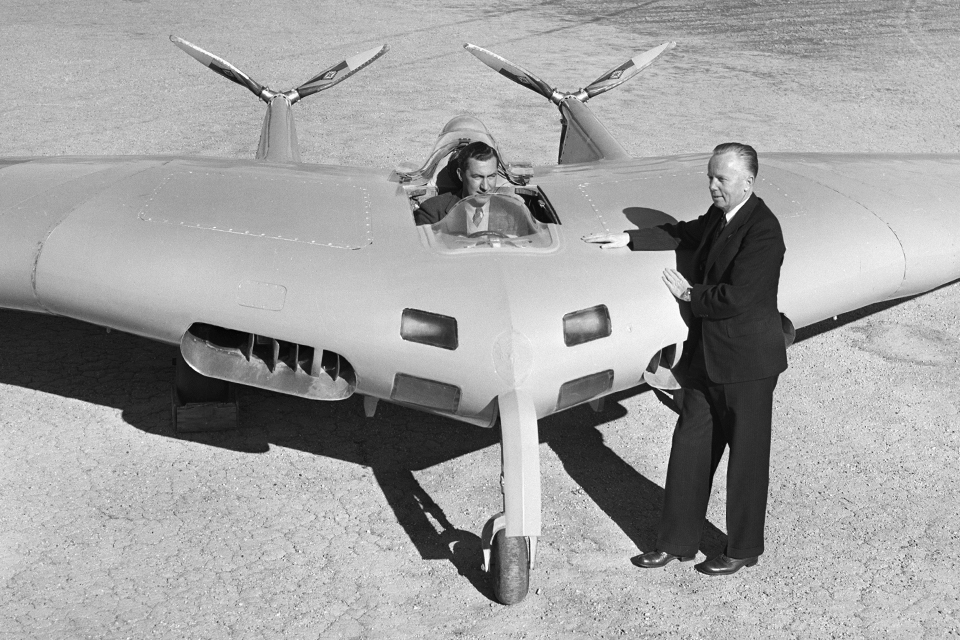 |
| John K Northrop (rt) and test pilot Moye Stephens |
I've always felt good about my time at that school and the quality of the education I received. And I could point to others in the aircraft and defense industries who were shining examples of what was good about NAI & NIT.
Sometime in probably mid-1991 I learned from a co-worker at Lockheed Missiles & Space Co. that the engineering school had closed. We both were graduates of NIT and we both were very surprised by the news. He talked about a bad real estate investment for a new school location. That went badly and had caused the school to close. While I was disappointed by what I heard, it was ancient history and I was just 4 years from retirement.
.jpg) |
| Model of the planned new campus for Northrop University (ex-Northrop Inst. of Tech) - ca. 1989 |
I think I made mention of this story recently though I can't seem to find it in the blog at the moment. So I thought "I'll just do a Wikipedia search and see if anything pops up". A person really needs to be careful what they search for cuz when they find it, they just may not like what they read. And that's exactly what happened to me. Ugh.
Good ol' Wikipedia had the story all right. I found a thorough history of the school including what happened to bring about its closure. And it's not a very nice end to my college memories. There is still some remnant around which is owned by an aircraft maintenance training school named Rice. The school is for aircraft mechanics and is advertised as Northrop-Rice Aviation. That was the training facility for aircraft mechanics and was separate from the engineering school. It was and is a well respected institution for aviation mechanics and was always separate.
All of the engineering school is gone, however. Apparently it was the victim of poor management decisions which cost the school its academic accreditation. That accreditation fault was corrected and restored during late 1989-1990. But the damage to the engineering school's reputation was done. Attendance apparently had dropped from 1,900 students down to 998 which was insufficient income to continue. As mentioned above the aircraft maintenance portion of the school was, however, viable and was acquired by Rice Aviation after the engineering section was closed. From net searches I did in Sep 2025 that school continues.
I learned all this from a thorough article in Wikipedia- Northrop University.
There seems to be a few holes in the article which may be intentional to avoid legal issues. For instance they have no mention of the failed real estate venture in Thousand Oaks area of Los Angeles, California. But the information provided is sufficiently complete to understand someone got greedy, siphoned off a large amount of money and then got caught. Disappointingly I also learned that the person in question was also selling academic completion documents without the student having successfully completed the course work.
It's disappointing to hear of the disintegration of what was a useful and effective educational enterprise. But it's all gone- only remembered by those of us that were launched into the aerospace industry at an exciting time.
I'll try to track down some images from back in the day to pad this article.
------------------------------
A back-story-
John K Northrop started Northrop Aircraft before the US entered
WW-II. Northrop had some aircraft design concepts that were
not explored by many designers. He envisioned an airplane that consisted
of only it's most elemental components:
- the wing and
- engine-driven propellers
- control surfaces integrated into these basics.
To envision the concept, picture a boomerang with engines.
There were other aircraft design companies that also saw this as the future of aircraft development (at least for military aircraft) so Northrop had competition. With funding from the military he built a few prototypes and secured some interest from the USAAF- the US Army Air Force (I thought it was the US Army Air Corps... ??); later this changed to USAF. This means he was pursuing the concept in the 1930s. None of these concepts went further than prototype hardware. Plus Northrop's concept suffered a flaw that was not resolved for decades: directional stability at certain air speeds or flight conditions.
WW-II delayed progress of 'the flying wing' as Northrop shifted to support the war effort. As a design and fabrication factory, Northrop had the same issue as the other aircraft manufacturers: workers and designers were in short supply as the draft devoured the only prospects. To that end he decided that at least some of the drafting staff could be trained to do the engineering tasks. Draftsmen (and -women) created the engineering drawings of what was to be built. This was done under the direction of engineers who had separately determined the design details of shape, structure, materials, thicknesses, shape details, etc. He thought 'why not take the best of the drafting staff and give them more education and make them engineers'? None of this addressed anything to do with a diploma or academic degree.
And that's what he did. Northrop took the best and the brightest of the drafting staff and taught them how to determine the forces and stresses the structure must endure. Then they would determine the appropriate shape and material thicknesses to endure the in-flight, landing, takeoff and maneuvering loads required for a combat aircraft. His training solution was implemented before the end of the war and became Northrop Aeronautical Institute after the war was over: a school that had at its roots the concept of creating a functional engineer in the shortest time possible.
Northrop had an employee who assisted in implementing the training concept- James L McKinley. There was a McKinley who was actively involved in operating the school when I was a student at Northrop Aeronautical Institute starting in the fall of 1957- I assume he was the same McKinley chosen by John K Northrop.
The curricula in 1957 required 12 'terms' to complete; each term was 8 weeks. The school operated 48 weeks per year with 2 weeks off mid-summer and 2 weeks off at year-end. And btw, the academic 'term' was originated by Stanford University in the 1920s. As McKinley implemented it, a term was 8 weeks long with as many as 4 class periods per day (I had 3 classes per day until the Bachelors degree was introduced in 1959). Each class was 2 hours per day, 5 days per week. We all carried a class load of 3 classes per term. That's 80 hours per class per term x 3 classes = 240 hours of instruction per 8 week term. It required 2 years of 48 weeks per year to graduate with a diploma. A test was given in each class every Friday covering the preceding week of lectures & homework. No homework was assigned on Friday which vaguely followed the concept of a 'standard work week' of Monday thru Friday with weekends off- no weekend homework; no tests on Monday. Somewhat like having a job.
When the school started offering a BS degree it was required by the state of California to change to a 12-week quarter system. In my case the degree program added 3 quarters of 12 weeks per quarter which was a total of 2 years 9 months to receive my BS degree vs. 2 years to receive a diploma. Yeah, I know- too much information. Just keep in mind we're talking about ex-GIs going to school on the GI Bill and they wanted to finish the classes and get a paying job ASAP! Many of them - maybe most - were married with young families. In 1957 most of the students were ex-GIs returning to school after the Korean War (1951-52) and the post-war occupation which followed. There were even a few WW-II veterans who decided to give it a try, e.g. Dick Lyons who had the seat behind me in my first classes.
I was hired for my first job before I graduated. That first job out of school was as a design engineer at North American Aviation working on the XB-70 program. The XB-70 was a flying wing design with a triangular wing shape (vs. the alternate boomerang shape Northrop had implemented). This wing shape provided the in-flight stability which plagued the XB-39 that Northrop created. Several successful aircraft have used the delta wing shape.
 |
| One of two USAF XB-70- an experimental aircraft designed and built by North American Aviation in Los Angeles |
Notice how the wing tips are angled down a bit? That feature allowed the XB-70 to 'surf' the shock wave produced when the aircraft exceeded the speed of sound. During my 6 months at North American I designed a couple of the structural components inside that folding wing tip. The entire aircraft used innovative construction which was new to the industry including a stainless steel honeycomb skin. It was really a very amazing aircraft that was just too far ahead of 1966 manufacturing capabilities.


Comments
Post a Comment