I replied to a question posed to me on Roast.World...
... and thought it would make a good blog entry so I don't forget what I was thinking at the time.
Good morning Art-
Uh-oh. You may end up regretting you hit the Play button!! 😀 [This will be] Way more than you ever wanted to hear I’m afraid.
Anything I have to say about roasting is strictly personal opinion. I’m nothing more than a self-taught amateur. Yeah, I read a lot, but my reading is usually focused on resolving a specific issue and not understanding the universe of roasting for all applications and all bean varieties. There’s a lot of coffee out there that just doesn’t appeal to me.
Thompson Owen of Sweet Maria’s has been a good source thru his articles. Takes a lot of digging cuz the Sweet Maria’s search engine leaves something to be desired.
And I’ve gotten a few things from Scott Rao even though it may seem I’m a skeptic. Mostly I’m enough of a contrarian that I resist the urge to rigorously follow anyone’s process blindly. “There are a lot of ways to skin the cat!” There are so few coffee-roasting authorities out there that those professionals willing to tackle the subject in a written form that’s readable/usable by part-time roasters it ends up being devoured, savored and ultimately guarded as sacred doctrine by all of us wannabes. Kinda what we’ve done with Rao. He’s just trying to make a living and he doesn’t want to stand at a roaster all day to do it.
In Nov 2019 (?) Julio (the Bullet tech at SM) posted a profile on
this forum of a roast that had earned him a bronze medal in a roasting
competition.
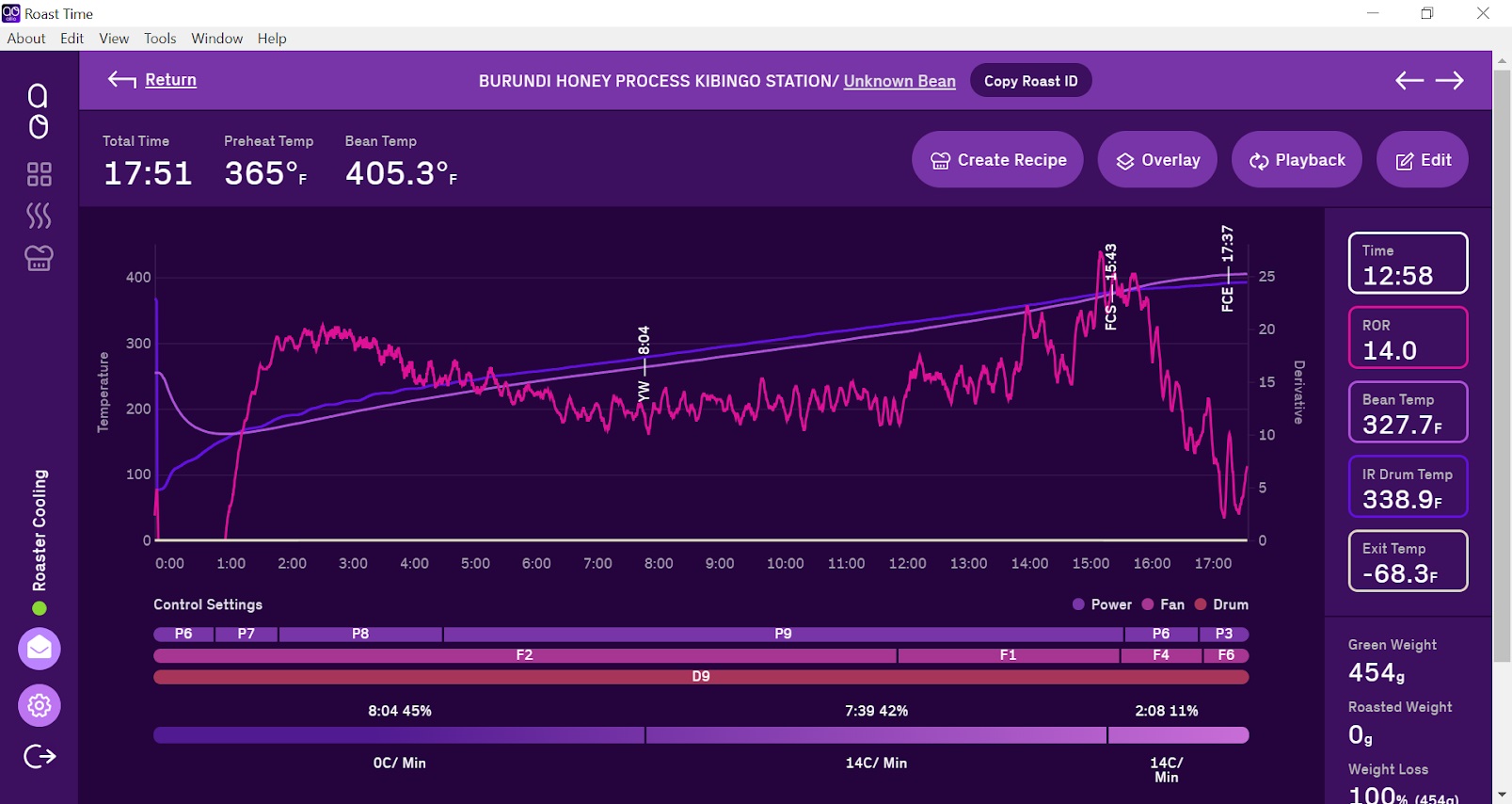
It wasn’t like anything I’d seen before but I could immediately see what Julio was doing- lower preheat and later application of roast-heat. Really interesting to me. He was largely ignored since what he posted ran across the grain of what folks think Rao is doing. (I found it annoying since I respect Julio and he’s been very helpful to me when I’ve needed parts; petty on my part!)
One of the most significant tidbits I got from Rao was that if you ramp-up toward the peak of RoR a little bit slower you will emphasize body (graph p. 32). From my time on alt.coffee (a newsgroup I haunted in 2003/2004) I recalled that chocolate flavors in the beans develop later in the roast (to the extent the beans have chocolate flavors worth noticing). So I relate chocolate flavors as requiring darker roasts (confirmed by bean descriptions from SM) and those flavors go hand-in-hand with body. Since I’m not particularly a fan of acidity (again, see Rao p. 32) I could see my future. So I jumped all over that concept: slower application of heat at the front of the roast so that RoR peaked later.
About the same time I was visualizing this break thru, @quartzglen on this forum started talking about “heat soak” (Sep 2019). He seems to have disappeared from the forum but his input helped me see a more complete process which extended what I’d gleaned from Rao.
And one last thing: Rao writes about roasting in a professional environment. He’s talking about 25-50 kg capacity coffee roasters that have a mass which is orders of magnitude greater than our little 1 kg capacity Bullet roasters. Thermodynamics doesn’t scale well with that kind of difference in mass, heating from gas vs. electrical power, cooling capacity that is enormous compared to a tiny centrifugal fan, and a centrifugal chaff collector instead of a tiny screen cup.
So with all that as preface, I have no hesitation sharing my opinions with someone that might think there’s at least a chance there’s more than one way to roast coffee even if that that one way seems to make a lot of people on Roast.World very, very happy! (I’ve never heard anyone complain about the quality of roast they get by rigorously following Rao!)
@Bradm has put a lot of effort into learning to use the Bullet really well. He has a great touch at managing heat and seems to guide RoR to zero at exactly the end temperature he wants. I wish I had his skill as an operator!
My own roasts get to the end in more time than I want to use. I’d like to hit about 10m +/- but I can’t do that without using power = P9. I believe that extra duration adversely affects the coffee flavor (more exposure to smoke). I currently roast Liquid Amber for a neighbor (he buys the beans and I do the roasting). He says he’s happy with the results. I had to stop roasting for my wife and I… we were getting too much caffeine which was bothering our sleep. If I was roasting for us as well I could experiment, but I need to limit experiments to my own coffee, not what I do for someone else.
My most recent effort was a crap job of managing heat at the end of the roast. Since I didn’t have a few roasts thru the Bullet ahead of the Liquid Amber, the internal masses of the Bullet weren’t properly stabilized. I did a Playback of a roast that I was happy with, but since the internal temps weren’t sufficiently stable I had all sorts of power, fan and drum speed adjustments that should never have been necessary! (I can picture @Bradm rolling his eyes at what I was doing!). This is the roast I was Playing back but if the initial conditions and the ambients aren’t right, a Playback just won’t work and you end up with control complexity that shouldn’t have been necessary.
The source-roast for the Playback ended at 10m 09s; the 2 roasts I did ran longer cuz the total mass of the Bullet wasn’t stabilized, especially since room ambients were lower. Btw, @quartzglen mentions thermal stabilization in his description of his heat soak roast process. He does a throw-away roast to get stabilized. I don’t have a source for junk beans so every roast counts.
So there you have the whole saga of how I came to roast with a RoR
that looks like a double-hump camel. It wasn’t my intent to be a
contrarian but I do get a kick out of people wondering “what does he
know that I don’t!” Well the answer to that is: “not one damn thing!” 😇
Bruce
1- Derrick at Aillio just got the Roast Analyzer installed & running on beta.roast.world. Good to have that back again!
2- As an aside, if you have a background in math beyond algebra, keep in mind that RoR represents the slope of the Bean Temp curve; an approximation of the 1st derivative of BT. The BT curve doesn’t have a double hump but there are changes in the slope of the BT curve that coincide with the to peaks in RoR. In a roaster with significantly greater mass (hundreds of pounds in the drum) you won’t see that initial hump in RoR.
3- re: not using P9… in Rao’s new book (“Best Practices”) he talks about RoR collapsing just after 1C. I could see that in my roasts but I was already at P9. So I backed off to P8 in order to save P9 for after 1C. In the mean time I learned I can use drum speed to manage RoR very effectively. So I will go back to using P9 at some point,
So there we go... double the miles.


Comments
Post a Comment